To start off, the definition of a virus is a non-living entity made of double or single stranded DNA or RNA. A new unit of virology has risen that reconsiders how we may approach viral origin. Astrobiology is the study of the origin and evolution of life within our universe. It is debated how we approach viruses in astrobiology. Some argue that because viruses are not alive it should be grouped in this discipline. Though, other scientists believe that viruses are the connection to the origin of life on earth. So if it hypothesized to have a connection to the origin of life on earth then why this would not be considered to be associated with life in space?
How has the presence of viruses been associated with the origin of life?
NASA defines life as a self sustaining chemical system capable of darwinian evolution. Viruses are chemical systems, but do not sustain without a host and cannot utilize matter and energy from an environment to create an internal order. Viruses that contain an RNA genome are hypothesized to be very ancient and associated with genetic elements that lead to life on earth and influence evolution. Early viruses are considered a “gray zone” of entities that can store and transmit information and has an active form that infects cells to reproduce.
There is a limited understanding for how viruses can survive in hosts in extreme environments such as ancient earth conditions. Virion forms of viruses in particular can withstand conditions better then cellular forms of life. Knowing this information about the limits of virus activity can help better understand life in space. The new taxonomic ranking system using viruses realms shows six families of viruses that do not have a common ancestor, however they all share the RNA replication motif that is hypothesized to have been present before cellular life. If viruses predate cellular life then it connects to the hypothesis that viruses influenced the evolution of eukaryotic cells. The discovery of viruses in space can also question whether life can be in space as well because of these current hypotheses.
Jupiter’s moon Europa is thought to contain a aqueous layer below the ice surface with a high salt concentration. It has been tested if microorganisms such as Bacillus pumilus and Halomonas halodurans have a higher growth rate in different liquid cultures of NaCl. It was found that both strains are halophilic with higher concentrations in sodium sulfate. This experiment was linked to show that life bacterial presence on Europa is possible and if it is confirmed this can influence the existence of viruses on Europa as well. In fact, it would be interesting to know if the waters on Jupiter’s moon Europa have a virosphere similar to the waters in our oceans here on earth. Would these viruses be considered a viron state? Or will these viruses have some unknown host on Europa?
These questions are hypothetical, but they emphasize the importance of the discovery of water outside of our planet. Our ocean contains millions of viruses per a millimeter of seawater. Europa contains an ice layer before it hits the aqueous portion. Would the presence of viruses on Europa hold viruses similar to permafrost? Permafrost viruses are ancient with some even dating back to the Holocene and Pleistocene. The field of Astrovirology opens up new pathways to understanding ancient viruses and questions the function and presence of viruses beyond our planet.
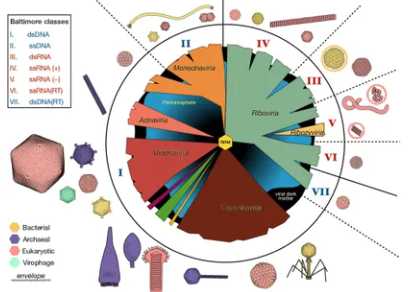
New taxonomic ranking system of viruses. Image depicts the diversification of viruses using the Baltimore classification.